Archive for the ‘Uncategorized’ Category

Hope Through Endurance

Posted: May 2, 2015 in Uncategorized
Tags: ,
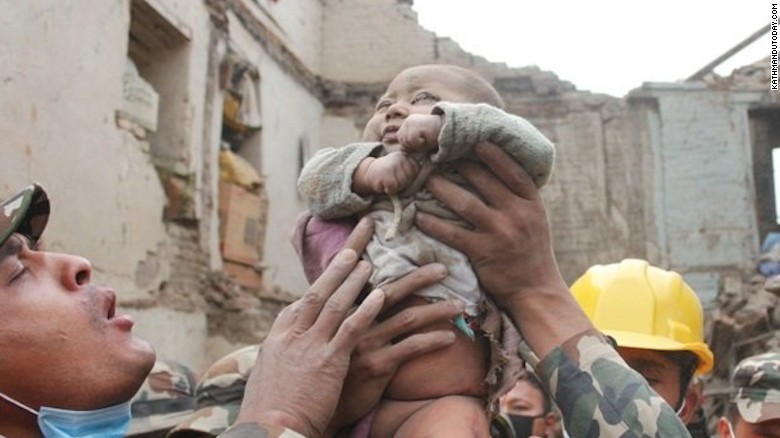
Photo: Amul Thapa, KathmanduToday.com via AP

Photo: Amul Thapa, KathmanduToday.com via AP.

This week a photograph of 5-month-old Sonies Awal being held aloft has become a symbol of hope.

Sonies was found alive in the rubble of his family home in Muldhoka, Bhaktapur, east of the Nepalese capital, Kathmandu, 22 hours after the devastating earthquake that killed more than 6000 people and left hundreds of thousands homeless.

Amidst awful scenes of hopelessness the discovery of a baby alive lifted the spirits of many and as the pictures spread around the globe the stories of survival helped to provide hope to a world that seems to have seen more than its fair share of natural disasters.

Hope is more than just a fanciful wish that things will get better. When a nation has been devastated by an earthquake hope enables the rescuers to keep searching; to keep listening for the muffled sounds of life below the rubble. Hope enables those people in positions of responsibility to plan for life after the clean-up has been completed. Hope motivates architects, town planners and builders to design for a future that is likely to include more natural disasters, but will also see babies born, relationships blossom, dreams realised, ideas developed and creativity nurtured. Hope motivates people hundreds of thousands of kilometres away to donate funds towards relief efforts.

On the back of the door in my office I have pinned these words that relate to the way in which hope can help in the process of change for those affected by mental illness and addictions:

Hope is the limitless belief that things do not have to remain the same and that change can and does happen. It is about concentrating on strengths rather than weaknesses, focussing on the future rather than the past and celebrating small successes rather than insisting on rapid change…

The apostle Paul put it this way:

Now that we have been put right with God through faith, we have peace with God through our Lord Jesus Christ. He has brought us by faith into this experience of God’s grace, in which we now live. And so we boast of the hope we have of sharing God’s glory! We also boast of our troubles, because we know that trouble produces endurance,  endurance brings God’s approval, and his approval creates hope.  This hope does not disappoint us, for God has poured out his love into our hearts by means of the Holy Spirit, who is God’s gift to us. (Romans 5:1-5 Good News Translation)

The picture of baby Sonies in Nepal is not only a picture of hope for a nation, but a picture of God’s love for all people; a picture of hope and grace that rises out of endurance.

smithyThis week I had the opportunity to meet John Smith, the first president of the God’s Squad Motorcycle Club. We first met John about 25 years’ ago when he stayed with us at our home in Derby, so it was great to catch up with him.  At that stage John had been leading God’s Squad for about 15 years, providing a Christian presence among outlaw biker groups.

Smithy is described in his profile as an author, a social anthropologist, a business speaker, a teacher and lecturer, a biker, a defender of the poor and marginalised, a lover of blues music, a gifted evangelist, an elder of the radical discipleship movement, and a prominent social commentator. He has shared the stage with former President Jimmy Carter and has addressed the United Nations Human Rights Commission.

Despite battling cancer for about 15 years, John hasn’t stopped travelling, speaking and writing. In fact he has recently published a new book, Beyond the Myth of Self Esteem. In this book he uncovers common myths about self-esteem and explores their effects on individuals and society. He talks about the way in which the search for good self esteem and happiness has led to a cult of perfectionism.

I used to say, ‘I don’t want to talk to anyone who has not suffered because they usually have nothing to say.’ That may be overstating the case, but my experience has been that those who have encountered disappointment and tasted failure are the wiser for the experience if they rise above despair and confront their situation appropriately.

He went on to say:

If we invest our lives in creating a bubble of perfection to avoid pain, then we are heading for disillusionment. Sometimes feeling ‘bad’ or uncomfortable is the appropriate response to our circumstances; our challenge is to learn to deal with these feelings in healthy and authentic ways.

Smith argues that the western approach to self esteem has led to us thinking that the purpose of life is to find ourselves, but that there is actually something more: the search for meaning and purpose beyond ourselves. In fact, he says, the increasing focus on self has led to the diminution of the person. Smith’s many years of working with outlaw biker gangs and the poor and marginalised in many parts of the world, has led him to being convinced that self-surrender to God, not the search for self-esteem, is the ultimate means by which we find ourselves.

He concludes by saying that if anyone is motivated to explore the spiritual dimension they should include an examination of the person and teachings of Jesus Christ.

As one who long ago surrendered himself to God as revealed in Jesus, I can say that this has been the wisest, most fruitful and most fulfilling decision of my life. I have found where I truly belong. I agree with Augustine of Hippo, who some 1600 years ago summed up relationship with God in this way: “You made us for yourself and our hearts find no peace until they rest in you.”

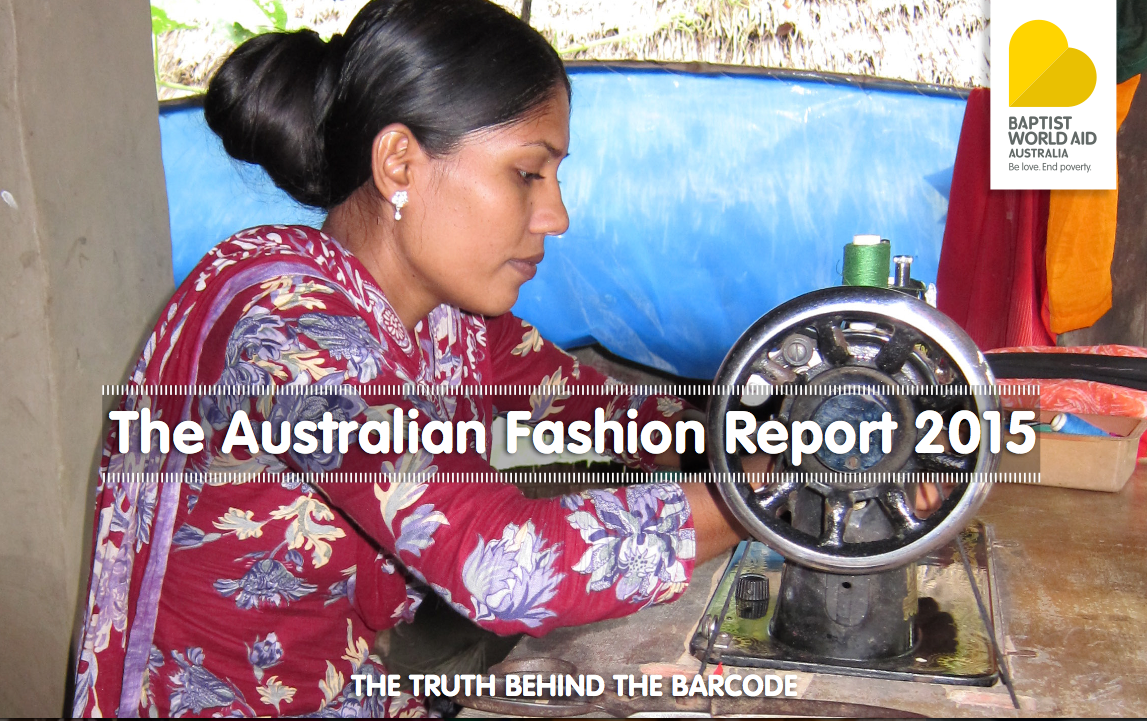
Screen Shot 2015-04-17 at 10.05.44 amWhat influences our purchase of fashion garments? Other than how it looks, the price and the size is there anything else that will help us in making a decision. There are probably few of us who think about where our clothes have been made, the amount the manufacturer’s have been paid, or a whole range of ethical issues with the production of our clothes.
For me, the whole process of buying clothes is hard enough without having to think about the ethics of what I’m buying, but if I’m serious about following Jesus’ instructions to love my neighbour I need to think about those people who are facing incredible hardship in order to give me the privilege of going into a fancy shop to buy nice clothes … and I now have some information to help me influence the big companies that provide my clothes.
It’s been two years since the fatal factory collapse in Bangladesh, that saw the death of 1,100 factory workers. After that event Baptist World Aid produced the 2013 Australian Fashion Report to help consumers, retailers, investors and governments to know more about the people producing our clothes and how they are treated.
This week the follow-up to that report, the 2015 Australian Fashion Report was released by Baptist World Aid. You can take a look at the full report HERE. It includes an additional 18 companies representing over 91 brands and there have been some significant improvements.
Of the companies researched in our last publication, a remarkable two thirds have improved their labour rights management systems, 100% now have codes of conduct (up from 85%) and the number of companies that actively engaged with the research process has increased from 54% to 94%. Some companies that have made significant improvements include Kmart, which has released a complete list of its direct suppliers, a huge step towards transparency; The Cotton On Group, which has taken big steps forward to identify suppliers deeper in their supply chain; and H&M, Zara, Country Road and the Sussan Group which have demonstrated that they have made efforts towards paying better wages for workers overseas.
The Fairtrade companies once again are a stand out, with all their brands receiving A grades. Etiko still retains top honours, having traced its entire supply chain and taken action to ensure workers at the inputs and final stage of manufacturing levels of the supply chain are being paid a living wage. Etiko’s performance is only matched by the newcomer, Audrey Blue, who shares Etiko’s supply chain. The Cotton On Group takes honours for being the highest rated, non-Fairtrade Australian retailer, while H&M and Inditex, the two biggest fashion retailers in the world, are amongst the best rated international brands, receiving A-
grades while also taking action to ensure workers at the final stage of production are being paid above the minimum wage. Only Hanesbrands received a higher grade, an A, but has yet to demonstrate any action on improving worker wages.
But the news isn’t all good. The report tell us:

While there are promising signs for the fashion industry, the problems remain significant. Overall the industry is still categorised by poverty level wages. A mere 12% of companies could demonstrate any action towards paying wages above the legal minimum, and even then, only for part of their supply chain. Furthermore, 91% of companies still don’t know where all their cotton comes from, and 75% don’t know the source of all their fabrics and inputs. If companies don’t know how and where their products are made, then there’s no way for them to ensure that their workers are protected.

Sadly, many of the worst overall performers were iconic Australian fashion brands such as the Just Group (owner of Just Jeans, Jay Jays, Dotti, Peter Alexander and Portmans), fast retail brands like Ally, Valley Girl, Temt and Industrie, and low cost suppliers like Lowes and Best & Less. These companies have all received D or F grades. We could find little evidence that any of these fashion retailers were doing much, if anything, to protect workers overseas. Many of them had little or no publicly available information and/or didn’t respond to any of our requests to engage with the research process.
Take a look at the report and consider the consequences. Congratulations to Gershon Nimbalker and the team at Baptist World Australia who have put this report together to help us make decisions that will help the less fortunate.
Yuri Gagarin - Wikipedia.

Yuri Gagarin – Wikipedia.

Today, April 12, is known as Russian Cosmonaut’s Day because on April 12, 1961, Russian astronaut Yuri Gagarin became the first man in space aboard Vostok 1. It took another 8 years until 20 July 1969 when the first human being landed on the moon.

One of my favourite songs when I was learning to play the ukulele as a child included the lyrics, if I can recall them correctly, “if man should ever reach the moon he’ll ruin everything up there as he has done down here”.

That dates me doesn’t it?

Fortunately, all those years later we haven’t messed up the moon yet, but we’re still doing a pretty good job at messing up the earth.

This morning at church I showed the picture that was released by the Hubble telescope earlier this year of the Andromeda Galaxy. It’s an amazing picture that helps to give an idea of the vastness of the universe.

As we looked at the picture of the Andromeda Galaxy I read the words of Psalm 8:

Psalm 8

Lord, our Lord,
    how majestic is your name in all the earth!

You have set your glory
    in the heavens.
Through the praise of children and infants
    you have established a stronghold against your enemies,
    to silence the foe and the avenger.
When I consider your heavens,
    the work of your fingers,
the moon and the stars,
    which you have set in place,
what is mankind that you are mindful of them,
    human beings that you care for them?

You have made them a little lower than the angels
    and crowned them with glory and honor.
You made them rulers over the works of your hands;
    you put everything under their feet:
all flocks and herds,
    and the animals of the wild,
the birds in the sky,
    and the fish in the sea,
    all that swim the paths of the seas.

Lord, our Lord,
    how majestic is your name in all the earth!

It’s Easter Sunday

Posted: April 5, 2015 in Uncategorized

Thought this video was worth a link for Easter Sunday.

Vale Richard Hill

Posted: March 31, 2015 in Uncategorized
Tags: , ,

richardToday I attended the funeral of a true gentleman, Richard Hill, who died at the age of 54.

Richard was a humble man with a great sense of humour and the ability to make anyone who met him consider themselves a friend. He was a champion in every sense of the word and was a leader among leaders.

Diagnosed at a very early age with Muscular Spinal Atrophy, Richard spent much of his life in a wheelchair, but did not allow that to stop him from living life to the full. In fact he used his abilities to influence change at the highest levels. Western Australia has lost one of its most effective disability advocates.

Richard taught me some very important lessons about disability when I met him nearly 10 years ago. He came to Baptistcare seeking support, but in a short time I realised that providing support was not something that we do “to” people, but something we do “with” people. Richard employed his own support workers and managed all his own services. He didn’t require a service provider, but a partner who would work with him in helping achieve a good life.

Richard’s approach to disability and the way he championed “self-management” at a time when governments weren’t sure it if was possible, had a significant impact on the way I worked from that time on. He taught me in his gentle way that true support doesn’t start with the support organisation’s wisdom, expertise and authority, but starts with the person; hearing their story, listening to their dreams and honouring their life.

Richard Hill, thankyou for your influence on so many people, and a life in which your many abilities shone brightly.

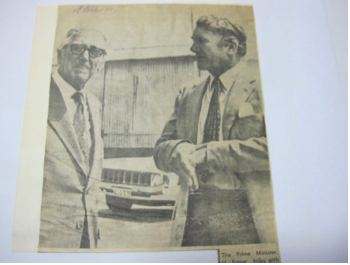
Executive Director of Western Mining Corporation, Sir Laurence Brodie-Hall with Prime Minister, Malcolm Fraser in Kalgoorlie. Photo by Rob Douglas, Kalgoorlie Miner

Executive Director of Western Mining Corporation, Sir Laurence Brodie-Hall with Prime Minister, Malcolm Fraser in Kalgoorlie. Photo by Rob Douglas, Kalgoorlie Miner

The death of former Prime Minister Malcolm Fraser has prompted memories of one my most embarrassing career moments. I was a journalist with the Kalgoorlie Miner in the late 70’s when the Prime Minister made a visit and I, along with a local ABC journalist were given the opportunty to attend a press conference in his hotel room.

My ABC colleague and I were awestruck by the event, and the large contingent of journalists who were travelling with him who were lined up around the room. The journalists were told they were to give the two local journalists the opportunity to participate in the interview.

My first impression of the Prime Minister was of a tall and very imposing figure, but what followed was the realisation that I couldn’t keep up with a man who spoke quickly and with great detail. Using some shorthand and my own abbreviated version of longhand I desperately tried to make notes of the interview, but knew I was struggling to keep up.

When I got back to the office, the editor asked how I had gone and I responded confidently, but when it came to reading back my notes I realised I would be struggling to write a story that adequately reflected the interview I had just attended. I quickly went to visit my colleague at the ABC – who was similarly overwhelmed by the event – to compare notes before placing my completed story on the editor’s desk.

What could have been one of the highlights of my career had turned into one of my most embarrassing moments. That night the Kalgoorlie Miner went to bed with a local story about the Prime Minister of Australia, Malcolm Fraser, but the local journalist who wrote the story wasn’t confident he had come up with his best piece of work.

roadkillThose who have driven on roads in the north west of Western Australia are familiar with Wedge-tailed Eagles sitting on the roadside eating roadkill. It’s not a pretty picture for a bird that looks so regal when it is high up in the sky, it’s great wings spread out majestically.

This morning I shared at church the verse in Isaiah 40 that reads: Even youths grow tired and weary, and young men stumble and fall; but those who hope in the Lord will renew their strength. They will soar on wings like eagles; they will run and not grow weary, they will walk and not be faint.

I can relate to the idea of God lifting me above the troubles of the world and delighting in Him through prayer, meditation and worship, but I can also relate to sitting on the ground eating roadkill. It seems that while I want to soar like an eagle, I spend more time grovelling in my own worries and fears.

EagleswingsSo how do we get to soar like eagles? Well, eagles don’t just sit back hoping. They actively chase the thermals – updrafts of warm air – and as they follow the various air currents they are able to fly long distances using little energy.

Isaiah says that those who hope in the Lord (or, wait with anticipation) will renew their strength and soar on wings like eagles. It takes an act of the will to actively seek God and to delight in him through prayer, worship and meditation. When we’re not doing that, we just may be on the side of the road, eating roadkill and dodging passing cars.

I know where I’d prefer to be.

(You can hear this morning’s message online. Click here)

MagpiesI was watching a group of magpies eating the other day. It’s that time of the year that the baby Magpies are demanding a feed. They squawk very loudly until their parents come and feed them.

The interesting thing I noted was that the parent will often have something to eat themselves before taking food to the baby.  It seems a bit selfish, but I think there’s method in their madness. It’s a bit like the instructions you get on a plane. At the beginning of a trip, safety instructions are provided and you’re told that if you have children put your own oxygen mask on before you put one on your child.

The principle is simple. If you’re not safe yourself, you’re not in a position to make your child safe. Magpies have worked that one out.

Counsellors, too, are very much aware that if they are going to be effective in helping people, they have to look after their own mental health first.

Some people are naturally very caring and want to help people who they see are in need, but at times they put themselves at risk in the process of helping others. While we need to care for others we also need to care for ourselves.

There’s a few ways we can do that. We need to look after ourselves physically, to make sure we eat properly, have proper exercise and not to over-indulge. We need to protect our relationships and we need to guard our time to make sure that there’s a balance between the amount of time we put into work, to family, and to what we may call self-care.

But the other area that often gets forgotten is looking after our spiritual health. Human beings are spiritual beings. Most parents want their children to grow up as healthy, well-balanced adults, and many parents are aware of the need of some kind of spiritual stability for their children.

But it’s easy to neglect your own spiritual health, while you worry about your children or another member of the family or a friend, who is in difficulty.  Spiritual practices like prayer, meditation and worship are important and help to build spiritual health.

But sometimes people think that this is enough of itself. God created people with the need to live in relationship with him. And good spiritual health is most achievable when we live in a healthy relationship with God. The Bible tells us that God loved us so much that he came to this earth himself in the form of a human being, Jesus Christ, and he gave up his life for us.

Jesus invites us to come to him, to admit our faults and failings, and accept his gracious offer of love and forgiveness. Find a quiet time to step aside from everything else that’s happening and have that conversation with God.

Being right with God puts you in a stronger position to be in a good place with yourself. It helps you to get a better perspective on where you fit in the world, and who you are as a person.

But it also puts you in a stronger position to support other people, to be a good role model and to have the spiritual strength to help others to grow as well. Check out the magpies next time you see them feeding their young. And remember if you’re going to be any good for anyone else, you need to look after yourself physically, emotionally and spiritually.

IMG_0453We’ve just had the carpet cleaners in to shampoo the carpets and clean the chairs in the church. It was a pretty big job and took quite a while.

I think there’s something therapeutic about the deep washing of carpets because as you go, you throw out buckets and buckets of mud and grime that have accumulated over time. Then when you think you’ve finished and go over it again, there’s still more.

Yet, before you do that you can walk over the carpet on a regular basis and not even be aware of the dirt that has been ground in to it. The carpet doesn’t necessarily look all that dirty, but the process of cleaning drags that dirt out and the buckets of muddy water that are thrown out are evidence that the carpets were probably dirtier than you thought.

We proceed through life every day, and we’re generally not aware of the dirt that accumulates in our life. I’m not talking about the dirt we get on our hands and feet, but the dirt that accumulates on our minds and in our very being.

As we watch television shows about crime and violence year after year, we become a little bit immune to it. Things that may have shocked us a few years ago don’t shock us any more. We enjoy relaxing in front of the TV to see comedians or to watch comedy, but over time discover that we laugh at things that once we thought were crude or inappropriate.

Little bits of dirt have accumulated on our minds, and we’re not aware that its there, But it builds up bit by bit and over time we don’t notice that we’re a little bit grubbier than we were before.

There was a time when you avoided people who told dirty jokes, you were more careful in the way you drove your car, you were less judgmental of people who were different to you.  Now, of course, you’re older and wiser, more tolerant, but somehow when you look back you realise there has been some slippage. Little bits of dirt have accumulated, and you haven’t noticed it.

In fact, somewhere in the Bible it says: All of us have become like one who is unclean, and all our righteous acts are like filthy rags; we all shrivel up like a leaf, and like the wind our sins sweep us away.  Now, you may think that’s a bit steep. After all, we like to think we’re basically good people.

But the reality is, the bits of dirt and grime we accumulate in our minds and hearts actually builds up into something quite disgusting when we compare ourselves with the purity, and beauty and holiness of an almighty God.

But there’s a solution. You can walk over carpet for years and put off the day you have to bring in the cleaners because you’re not prepared to admit how bad the carpet really is.  Same thing goes for our lives. The Bible also says that if we confess our sins … that means we actually admit that we’re sinners, God is faithful and just and will forgive us our sins and purify us from all unrighteousness.

Sometimes we have to admit that even though we vacuum the carpet regularly, we still need to bring in the carpet cleaners to do a proper job. We may assume we’re basically good people, but there comes a time when we have to admit that compared to God we’re nowhere near perfect.

If we’re prepared to confess our sin, and admit our need of God, he’s assured us he’ll hear that prayer and put us right with himself.